
Two Supplier Portfolios, Side by Side: Reading Case Studies for Gifting
Supplier portfolios are read as marketing far more often than as evidence, which is why two very different manufacturers can look equally impressive. Compare them side by side with the same questions and the same requested artifacts, and the gap becomes visible within one meeting. The useful distinction is not between good and bad imagery, but between a portfolio that shows a finished product and one that shows how the product was reached.
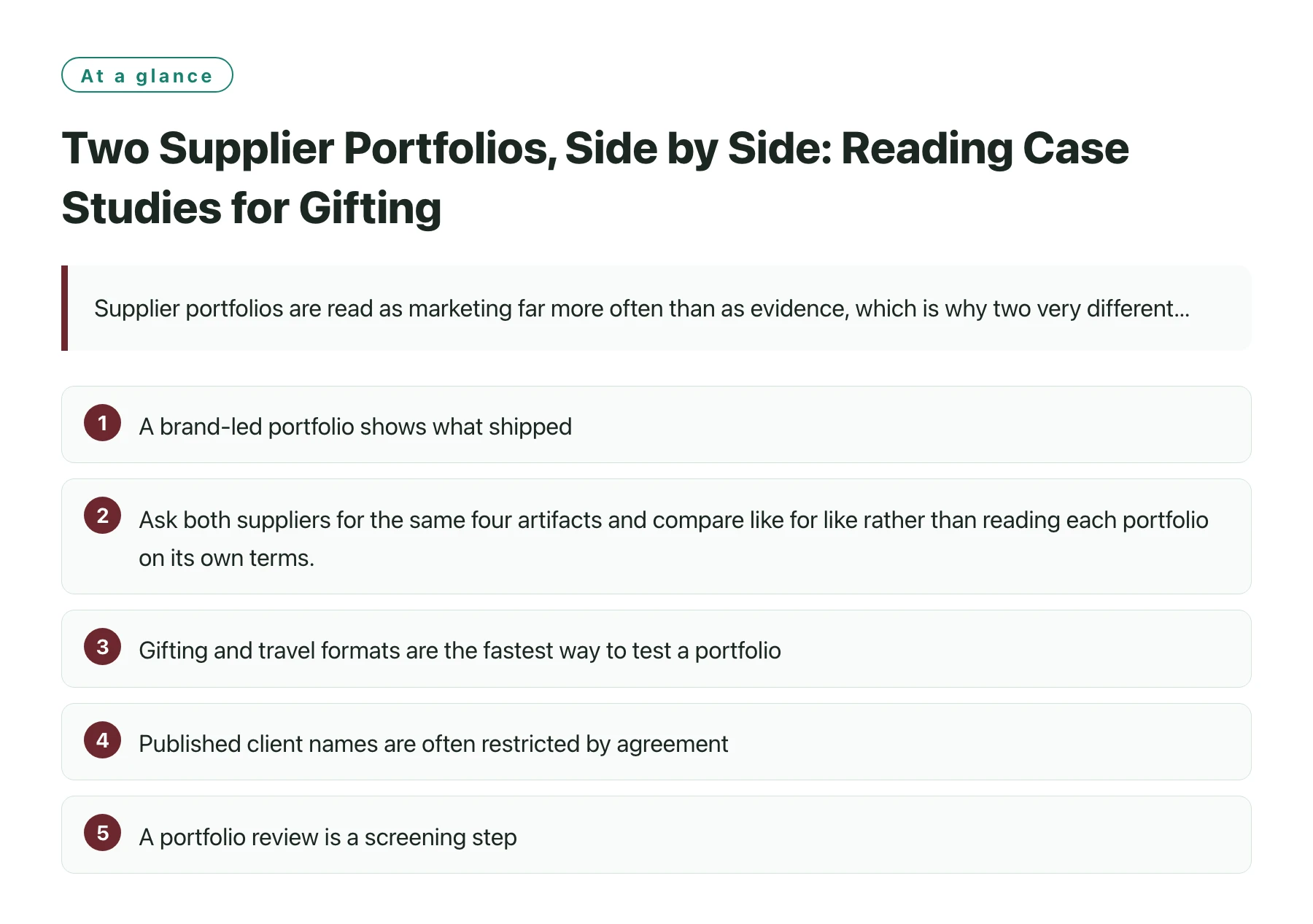
Key takeawaysA brand-led portfolio shows what shipped; a capability-led portfolio shows how it was developed, specified and inspected. · Ask both suppliers for the same four artifacts and compare like for like rather than reading each portfolio on its own terms. · Gifting and travel formats are the fastest way to test a portfolio, because small packs expose packaging, decoration and assembly claims that a single bottle can hide. · Published client names are often restricted by agreement, so the absence of logos proves very little on its own. · A portfolio review is a screening step, not a verdict: what it should produce is a shortlist and a specific list of questions for the next call.
Most buyers evaluate suppliers in sequence, seeing one portfolio this week and another next month, with different questions and a different mood. That method produces impressions, not comparisons.
This is a way to run the review properly: same evidence, same rubric, both portfolios open at once. It is deliberately mechanical, because the parts of a portfolio that matter are the parts that can be checked rather than merely admired.
Two kinds of portfolio, and what each one actually proves
Portfolio material falls into two broad styles. The first is brand-led: composed product shots, a logo wall, short descriptions of scent families. The second is capability-led: photographs of a filling line, a decoration process, a batch record, a sample log. Both are legitimate, and neither is sufficient.
What a buyer needs from a portfolio is enough detail to predict the experience of working with that supplier. That prediction comes from process evidence, because the product image at the end does not reveal how many sample rounds it took, who resolved a defect, or what happened when a component arrived late.
Market research houses track how frequently new fragrance products appear and which note families are being pushed [1]. That kind of context is useful for judging whether a portfolio reflects current work or a collection assembled years ago, which is a fair question to ask about any supplier's case studies.
The four artifacts worth requesting from both
Ask both suppliers for the same four things: one project described from brief to shipment, the inspection points used on that project, an example of a problem and how it was resolved, and the documentation list supplied at handover. These are all things a working factory has, so a refusal or a vague answer is itself informative.
None of the four requires disclosing a client name. The sensitive parts of a project are the brand and the commercial terms, not the structure of the process, so an NDA is rarely a reason to withhold the workflow.
Why small formats are the sharper test
A single 100 ml bottle can be produced by many different setups, including ones that would struggle with an assembled gift pack. A set that contains a bottle, a travel spray and a printed insert asks a manufacturer about component sourcing, decoration, line assembly and set-level inspection at the same time.
That is why a gifting project is a good test question even if your own line is not a gift set. Asking how a portfolio project handled a multi-component pack, and who inspected the finished set, reveals more about day-to-day capability than any number of beauty shots.
Trade coverage of the beauty and contract manufacturing sector is a reasonable way to cross-check what a supplier claims about its own focus areas [2]. Reading that coverage alongside a portfolio turns a sales narrative into a set of claims you can verify in the next conversation.
The same project, read two ways
| Evidence type | Supplier A: brand-led portfolio | Supplier B: capability-led portfolio | What it tells a gift-set buyer |
|---|---|---|---|
| Product imagery | Polished shots of finished bottles | Finished products shown beside components and packaging | Whether the pack is built or only photographed |
| Project description | Scent family, inspiration, launch story | Brief, sample rounds, approval date, shipment | Whether the timeline was managed or merely survived |
| Quality evidence | A certificate image | Inspection points named for a specific project | Whether quality control is generic or project-level |
| Problem handling | Not mentioned | One defect described with the fix applied | Whether the supplier can explain its own failures |
| Handover | Not shown | Document list supplied with the order | What you will hold after the shipment leaves |
Neither column is automatically better, and a supplier may show brand-led material to prospects while holding process evidence internally. The test is whether it can produce the second column when asked. If it cannot, the portfolio you are reading is the full extent of what the company is able to demonstrate.
How to run the comparison in one sitting
- Fix the rubric before opening either portfolioDecide the five evidence types you will score, so both suppliers are judged against the same list rather than against each other's strongest slide.
- Score each supplier separately, then compareRead A, write the score, close it, and only then read B. Side-by-side scoring without this pause tends to reward the supplier seen second.
- Send both the same follow-up listAsk identical questions, in the same order, in writing, so the answers can be compared without paraphrasing.
- Check the claims that are checkableCertificate scope, testing practice and restricted-material handling can all be verified; ask to see the document that supports each statement [3].
- Shortlist on gaps, not only on scoresA supplier that is honest about what it does not do is easier to work with than one that claims everything, because the first one's answers can be planned around.
Turning the review into a shortlist
A completed review should produce two things: a shortlist of two or three suppliers, and a written list of open questions for each. That list is more valuable than a score, because it turns the next meeting into a verification exercise instead of another presentation.
It is also worth reading a portfolio for what it repeats. If every described project follows the same pattern of brief, sampling, approval and shipment, the supplier is showing a process. If each project is described as a unique triumph with no structure, you are reading marketing, and the process questions will have to be asked from scratch.
Where a portfolio does not name the client, do not read that as a weakness. Confidentiality is normal in this industry, and the useful signal is whether the workflow is described in enough detail to be recognised as real. A manufacturer that publishes a portfolio of past work, such as the brands behind these scents, is offering a starting point for exactly this kind of comparison, not a substitute for it.
Use history as context, not as a proxy for fit
A long operating history is a legitimate thing to weigh, and it is one of the easier claims to check, since it usually comes with certificates, factory records and press coverage. a fragrance manufacturer with 31 years of experience is the kind of description that can be tied to documents rather than accepted as a slogan.
History does not make a supplier right for your project, though. A manufacturer with decades of work in one category may still be new to the specific format you need, and the portfolio review is where that should surface rather than during the first production run.
Ask what the contract manufacturer keeps in-house
One of the most revealing portfolio questions is which steps were performed internally and which were subcontracted. Almost every factory outsources something, and the answer is not disqualifying. What matters is whether the supplier knows where its own quality chain is handed off.
If your project depends on a specific step, such as decoration or set assembly, the follow-up question is who inspects that step and against what standard. A supplier able to answer this for a described project is usually able to answer it for yours.
Where the supplier presents itself as a contract manufacturer for perfume brands, the portfolio should line up with that description: developed scents, specified packaging and repeatable batches, rather than isolated one-off commissions.
Keep the review file. The two portfolios you compare today become the reference against which the first sample, the first inspection report and the first late delivery are judged. Buyers who keep the notes from the screening stage are the ones who can tell, six months later, whether a supplier is behaving as described or has quietly changed its story.
Sources
- Mintel Press Centre —— Mintel's press releases on consumer and beauty market research, including fragrance and personal care trend reporting.
- Cosmetics Business —— A trade publication covering the beauty and cosmetics industry, including fragrance launches and regulatory developments.
- IFRA Standards Library (International Fragrance Association) —— The IFRA Standards Library lists the restrictions the fragrance industry applies to individual fragrance ingredients, based on safety assessments; it is the reference point for compliant fragrance formulation.
Frequently asked questions
How many case studies should a supplier be able to show?
There is no correct number. What matters is whether at least one project is described in enough process detail to be checked, and whether the description matches the capability you need. A single well-documented project is more useful than a dozen product photographs.
Is it a red flag if a supplier will not name its clients?
Not by itself. Many manufacturing agreements restrict the use of client names, and a portfolio can describe a project's scope without identifying the brand. Treat a refusal to describe the process at all, rather than a refusal to name a client, as the warning sign.
What is the fastest way to compare two suppliers?
Send both the same written question list covering one project from brief to shipment, then compare the answers in writing. Identical questions in the same order remove most of the presentation effect and make the differences obvious.
Should I score suppliers numerically?
A simple score per evidence type is useful because it forces consistency, but the number should not decide anything on its own. Use it to identify where the two suppliers actually differ, then investigate those gaps with a direct question.
320,000+ issues. Every publisher. Zero subscriptions.
Same-day digital releases from Marvel, DC, Image, IDW, Dark Horse, Boom!, Dynamite, and Oni Press — readable in your browser in under three seconds.
Start Reading Free