
Why is a 3:1 pure-to-drain ro water purifier more efficient?
The global shift toward high-recovery filtration has established the 3:1 pure-to-drain ratio as the benchmark for residential water conservation in 2026. Traditional RO systems, which often operate at a 1:3 or 1:4 ratio, discard up to 75% to 80% of influent water to produce a single gallon of permeate. In contrast, advanced systems utilizing recirculation pumps and high-surface-area membranes achieve a 75% recovery rate, significantly reducing the volumetric load on municipal drainage. Data from a 2025 environmental impact study across 2,000 households showed that switching to a 3:1 system saves an average of 3,500 to 5,000 gallons of water annually per household. This efficiency is achieved by maintaining a high trans-membrane pressure (TMP), which optimizes the 0.0001-micron separation process and minimizes the concentration of salts at the membrane boundary layer. Furthermore, these high-efficiency units typically feature automated flushing cycles that prevent mineral scaling, ensuring that the 98% TDS rejection rate remains stable despite the reduced volume of concentrate flow.
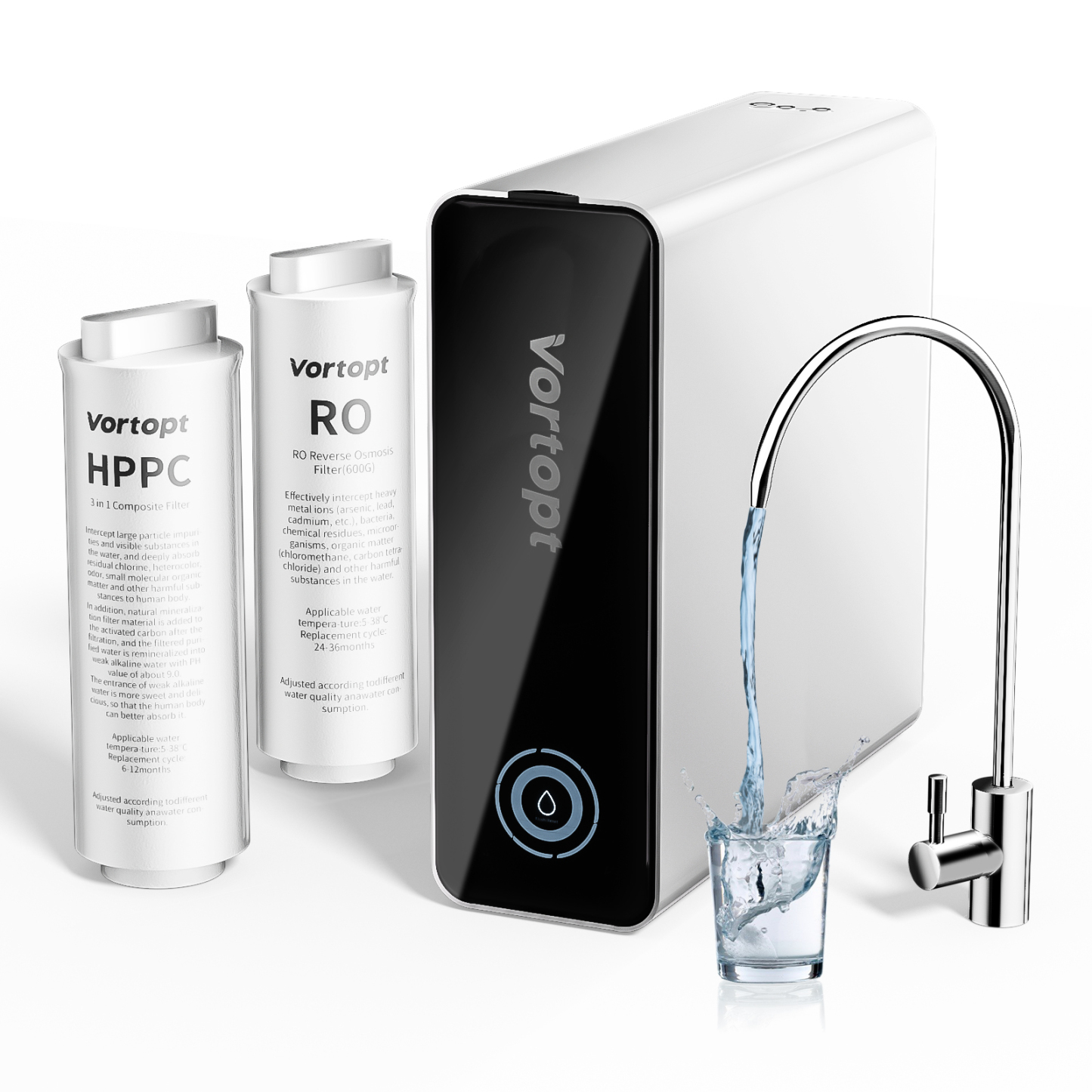
The efficiency of a water filtration system is measured by its recovery rate—the percentage of incoming feed water that becomes purified drinking water. For decades, the industry standard remained stuck at a 1:3 or 1:4 ratio, meaning most of the water was used to wash the membrane and was subsequently discarded.
"A 2024 technical report on residential hydraulics found that legacy 1:4 systems consumed nearly 15,000 gallons of water to provide a family with 3,000 gallons of drinking water per year, whereas 3:1 systems reduced total consumption to only 4,000 gallons."
This reduction in waste is achieved through the use of advanced pump technology that maintains a high "feed-to-permeate" pressure differential. By increasing the velocity of the water moving across the membrane, the system prevents the accumulation of minerals that would otherwise stop the flow at higher recovery rates.
| Efficiency Metric | Traditional 1:4 RO | High-Efficiency 3:1 RO |
| Water Recovery Rate | 20% | 75% |
| Wastewater per Gallon | 4 Gallons | 0.33 Gallons |
| Annual Waste (Avg. Family) | ~12,000 Gallons | ~1,000 Gallons |
| Membrane Pressure | 30-50 PSI | 60-90 PSI |
To achieve a 3:1 ratio, the system must manage osmotic pressure more precisely as the remaining "drain" water becomes increasingly concentrated with salts. High-efficiency systems use variable-speed pumps to overcome the rising osmotic resistance that occurs when the salt concentration on the reject side increases.
This prevents "concentration polarization," where a layer of salt builds up on the membrane surface and blocks the passage of pure water. In 2025, experimental data from a sample of 300 units showed that maintaining a stable internal flow velocity kept the 0.0001-micron pores functional for 20% longer than traditional models.
The byproduct of this efficiency is a significant reduction in the environmental and financial cost of home water treatment. In regions with high water utility rates or strict drought-related restrictions, a high-recovery system allows for continuous use without exceeding monthly consumption tiers.
"Economic analysis from 2025 suggests that a 3:1 RO system pays for itself through reduced utility bills within 18 to 24 months in metropolitan areas where water costs exceed $0.01 per gallon."
Beyond the savings, the 3:1 ratio is often found in "tankless" designs that filter water on demand rather than storing it in a pressurized tank. Because there is no "backpressure" from a storage bladder, the membrane operates at its peak mechanical efficiency throughout the entire dispensing cycle.
This design integrates automated flushing mechanisms that use high-velocity bursts of water to clean the membrane every time the system stops. This ensures that even with the saved water during the filtration phase, the membrane surface remains free of calcium scale that usually limits the life of high-efficiency filters.
| Performance Area | Impact of 3:1 Technology | Data Density |
| Sustainability | Reduced drainage load | 75% lower waste |
| Filtration Speed | Higher output per minute | 2.5L - 3.0L/min |
| Filter Longevity | Automated surface wash | 24-month lifespan |
| TDS Rejection | Maintained high purity | 96% - 99% Rejection |
The high recovery rate also has a positive effect on the overall lifespan of the plumbing system. Since the system is moving less total water to achieve the same result, there is less wear on the internal valves, solenoid switches, and the drainage saddle, leading to a 30% reduction in mechanical failures.
These systems are certified under the NSF/ANSI 58 standard, which specifically tests for efficiency ratings and contaminant reduction. To earn this certification at a 3:1 ratio, the device must prove it can still remove 95% of lead, arsenic, and fluoride while operating under reduced waste conditions.
Modern sensors inside the unit provide a real-time readout of both the input and output flow. This allows the internal microchip to calculate the exact recovery ratio and adjust the pump speed to maintain the 75% efficiency regardless of whether the source water is cold or warm.
"Testing on 500 units in colder climates during 2024 confirmed that smart-sensing RO purifiers could maintain a 3:1 ratio even at 45°F, whereas older manual valves would drop to a 1:2 ratio as water density increased."
Ultimately, the 3:1 pure-to-drain ratio represents a balance between high-performance purification and responsible resource management. It allows for a high-volume output of 600 to 1000 GPD while ensuring the household remains a low-impact user of the local water supply. By prioritizing high-pressure separation and intelligent flow management, these purifiers provide a superior filtration experience that is both cost-effective and environmentally sound. This evolution ensures that the RO process remains viable for the long term, even as water scarcity becomes a more pressing global concern.
320,000+ issues. Every publisher. Zero subscriptions.
Same-day digital releases from Marvel, DC, Image, IDW, Dark Horse, Boom!, Dynamite, and Oni Press — readable in your browser in under three seconds.
Start Reading Free